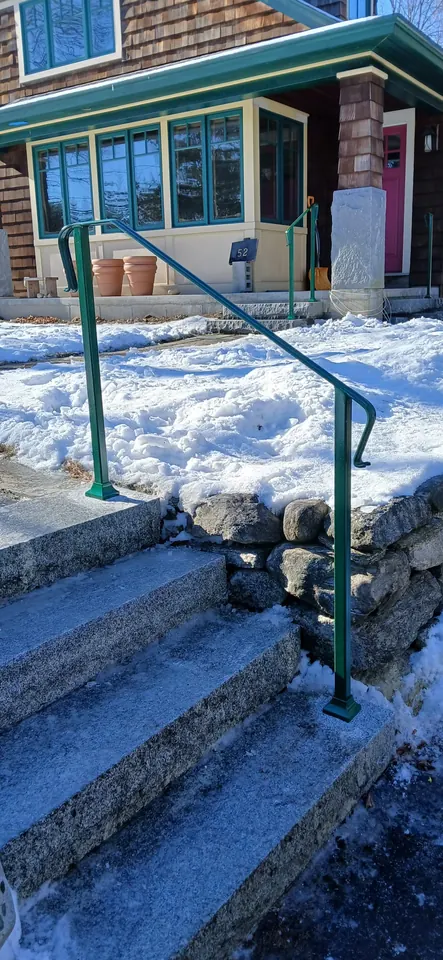
Short answer: salt and most ice melts are chlorides, and chlorides speed up rust wherever the finish on a steel railing is chipped. Rust almost always starts at the base of the posts, where melted slush sits. Keep ice melt off the posts, touch up chips before the first storm, and rinse the bottom of the railing with fresh water when the snow is gone.
| Ice melt on the label | What it does to a metal railing |
|---|---|
| Rock salt (sodium chloride) | The most common one. Corrodes bare steel wherever the finish is broken. |
| Calcium chloride | Works in colder weather. Hard on galvanized coatings, so keep it off galvanized posts. |
| Magnesium chloride | Pulls moisture from the air, so the metal stays wet longer and the finish works harder. |
| Sand or grit | No chemistry at all. Gives traction near the railing without feeding rust. |
Why winter is hard on steel railings
Steel rusts when water and oxygen reach the bare metal. A good coat of paint or powder coat keeps them apart. Salt water does two things to that barrier. It carries more current than plain water, so rust spreads faster under any chip. And it keeps coming back all winter, every time a storm is treated.
Massachusetts towns lean hard on salt from November to March. The slush from the street and the walkway ends up on your front steps, and that is exactly where an exterior railing is anchored.
Where rust starts on a railing
Walk around your railing and look low, not high. The top rail rarely fails first. These are the spots to check:
- The base of each post. Slush piles up against it and stays there for days.
- Base plates and anchor bolts on granite or concrete steps, where water sits in the joint.
- Welds and cut ends, because the finish is thinnest on sharp edges.
- Any chip from a shovel or snow blower. One nick at the bottom of a post can creep under the paint all season.
Habits that protect the railing
None of this takes more than a few minutes a month.
- Spread ice melt on the treads, not at the posts. Keep it a hand's width away from each post. Sand is a better choice right next to the metal.
- Shovel before you salt. Less snow means less ice melt, and less brine running down to the posts.
- Clear slush off the base plates after a storm so they can dry.
- Touch up chips in the fall. Wire brush the spot, prime it and paint it on a dry day above the temperature on the paint can.
- Rinse in spring. A hose on the lower part of the railing washes off the salt that built up over the winter. The American Galvanizers Association suggests the same fresh-water rinse for galvanized steel in salty settings.
When to call for repair
Surface rust that brushes off is a maintenance job. Call for a look when you see rust that flakes in layers, a post that moves when you push it, or cracked stone or concrete around an anchor. Those mean water has been getting under the finish or into the stone for a while, and the fix is usually at the base: a new plate, a re-set post or a section cut out and replaced in the shop.
If you are replacing a railing anyway, ask about the finish before you ask about the style. Galvanizing with paint or powder coat over it, which the industry calls a duplex system, is the strongest choice for steps that see heavy salt. The American Galvanizers Association reports that the two together last longer than both coatings would add up to on their own. Our exterior railing page explains how posts are set on granite, concrete and brick, and the material guide compares steel, aluminum and stainless.